
Norwich City Directory Shelves and Scans
Norwich has a rare local run that reaches from the earliest nineteenth-century volumes into the late twentieth century. Otis Library states that its printed Norwich directories span 1846-1986. Other shelves and scans fill different parts of that run, but no catalog proves that every intervening year is present. The table separates a located collection from a date that still needs volume-level confirmation.
| Collection | Years | Where Held | Access |
|---|---|---|---|
| Printed Norwich directories at Otis | 1846-1986 | Otis local-history collection | Genealogy room, staff-assisted |
| Stedman's Norwich and Preston | 1861-1874 | Otis and Eastern Connecticut State University | Library/reference access |
| Price & Lee directories | 1875-1920; later endpoint disputed | Otis and NPS bibliography | Verify the terminal volume |
| Price & Lee 1921 scan | 1921 | Google Books, scanned from NYPL | Free online scan |
| Eastern Connecticut backup | 1861-1960 | Connecticut Studies collection | Regional research copy |
| Federal and fiche references | 1927-1932; 1846, 1857, 1860 | NARA guide and New York State Library | Reference and fiche routes |
Stedman's Norwich and Preston title is especially useful before the Price & Lee sequence. One National Park Service bibliography ends the Price & Lee citation at 1920, while another Norwich nomination describes a later endpoint through 1931. Treat 1920 as a documented reference point, not proof that 1921 or later printings are missing. Otis staff can check the actual shelf.
Otis Library's Norwich Directory Shelf
Otis Library is the strongest first stop because its Genealogy and Local History Department brings several kinds of evidence together. Alongside the printed volumes, the holdings include Norwich vital indexes, the Barbour Collection, Hale cemetery and obituary abstracts, the Norwich Genealogical Biographical Index, Norwich Free Academy senior yearbooks, Norwich Bulletin microfilm and bound volumes, the Bulletin Index for 1865-1930, census microfilm for 1790-1920, Sanborn maps, neighborhood architectural surveys, scrapbooks, photographs, and local family histories.
The Otis Library genealogy collections page gives the clearest picture of that shelf and its related local-history material. Its broader genealogy page adds research-room and digitization context.
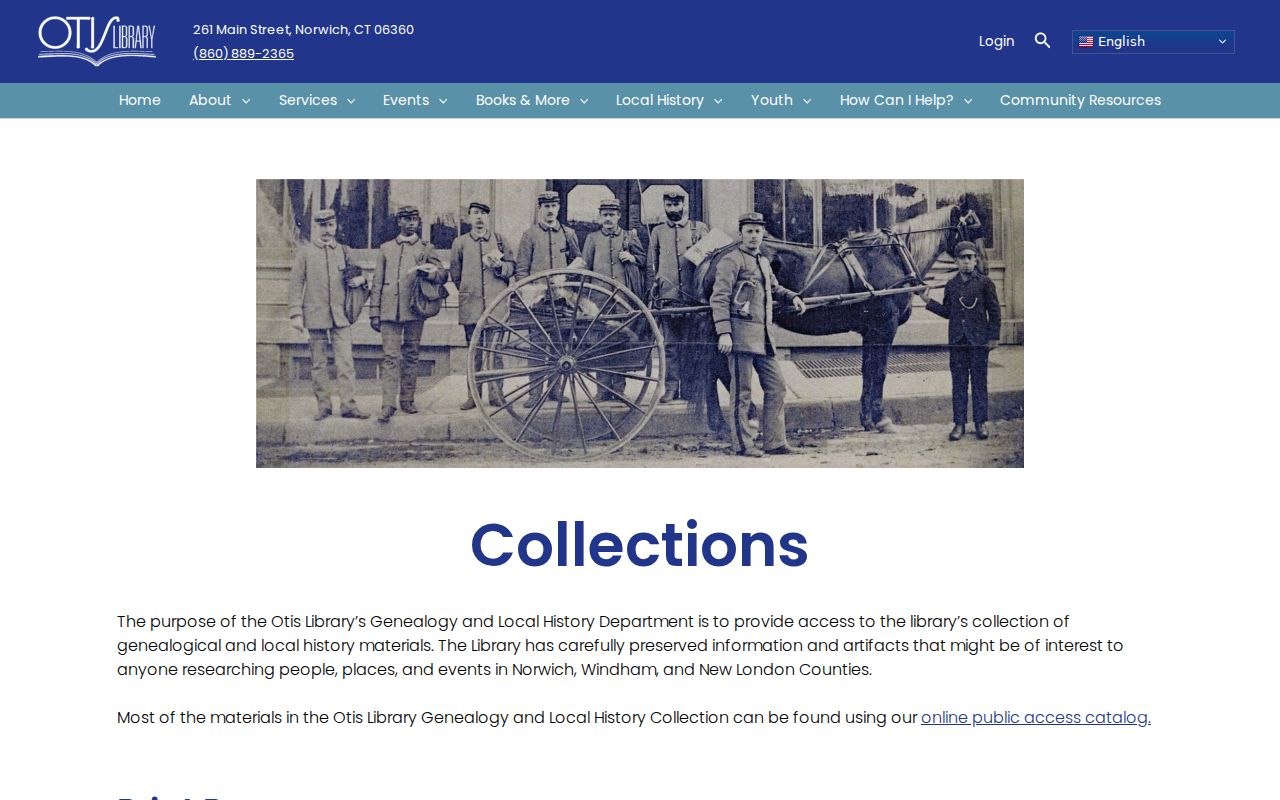
Those combined holdings let a directory name lead to a yearbook, obituary abstract, cemetery entry, or newspaper notice without treating any one index as complete. The listed genealogy-room hours are Monday and Wednesday, 9 a.m. to 7 p.m.; Tuesday and Friday, 9 a.m. to 5 p.m.; Thursday and Saturday, 9 a.m. to 2 p.m.; Sunday closed. Confirm holiday or seasonal changes before a visit.
Otis also holds local photographs and postcards. Its Sanborn holdings can be compared with located Norwich sheets from 1885, 1892, 1895, 1897, 1903, 1909, 1914, and 1926. A storefront, mill, school, or former street name in an image can explain why a printed entry uses a place label that is hard to match to a present address. Ask staff for the volume, page, image format, and any missing-year note rather than assuming the 1846-1986 statement means an unbroken annual set.
Norwich Directory Years and Publishers
The publisher sequence gives each printed Norwich volume a historical setting. Early references point to volumes for 1846, 1857, and 1860. Stedman follows with the 1861-1874 Norwich and Preston run. Price & Lee begins in the references at 1875 and carries the address trail into the twentieth century. That sequence matters when a family appears in one shelf but not another, since the name may be in a different publisher's format or a separate community section.
| 1846 | Early Norwich city directory reference, with an alternate access lead at the New York State Library. |
|---|---|
| 1861-1874 | Stedman's Norwich and Preston directory run, including older community vocabulary. |
| 1875-1920 | Price & Lee span cited in one NPS bibliography. |
| 1921 | Price & Lee volume available as a Google Books scan with searchable contents and OCR. |
| 1927-1932 | NARA city-directory reference range for the 1930 census era. |
| 1986 | End of the directory holding range stated by Otis Library, subject to volume checks. |
The 1921 scan is a useful bridge between a shelf reference and an actual page image. The digitized Norwich Directory volume has a contents page, OCR terms, street and community material, and advertisements. Read the image before trusting OCR, especially for initials, street numbers, and names shaped by local accents or older type.
How a Norwich City Directory Entry Reads
A printed entry usually works as a compact identity record. Start with the surname and given name, then mark the status or occupation, the street or neighborhood, and any relationship clue. An 1870 Stedman transcription gives examples such as May Miss Gertrude, bds 10 Broad; May Polly, domestic, 87 Union; May Stephen Lee, weaver, Occum; Mayhew Michael, teamster, Sturtevant, N T; and McCaffrey Martin, fac op, B H. The transcription is machine-generated, so the scan and the volume key remain the proof.
| Name | Surname, given name, title, initials, and sometimes a spouse or family relationship. |
|---|---|
| Status or work | Descriptors such as domestic, teamster, weaver, or fac op, meaning factory operative. |
| Address | House number and street, or a neighborhood, mill, landing, or town label. |
| Abbreviation | bds means boards, res means residence, h marks a home, and wid marks widow. |
| Owner or renter mark | Use only when the volume supplies a clear symbol or note. Do not add one by inference. |
- Criss-cross directory
- A street-order or address-order list used to work from a place back to a name. A Norwich volume must be checked for the section before the term is assumed.
- Householder index
- A name index organized around household heads or primary entries. It can shorten a search, but it does not replace the printed page.
- Abbreviation key
- The volume's own list of short forms. Photograph or transcribe it before expanding bds, res, h, wid, or fac op.
Record the year, page, exact spelling, address, descriptor, and the source of every expansion. A word that looks like an occupation may be a company or place name, and an address line may name a mill district rather than a current street.
Norwich Directory Street Sections
Alphabetic entries are only one route through a Norwich directory. The 1921 Price & Lee volume separates commercial entries, a street or community section, and advertisements. Those pages can recover a person when the surname is misspelled, the entry is filed under a spouse, or the family is better known by a mill, school, church, or neighborhood.
The 1921 Norwich directory scan makes that structure visible, including terms such as Broadway, Taftville, Yantic, Norwich Town, Occum, Laurel Hill, Shetucket, and NFA.
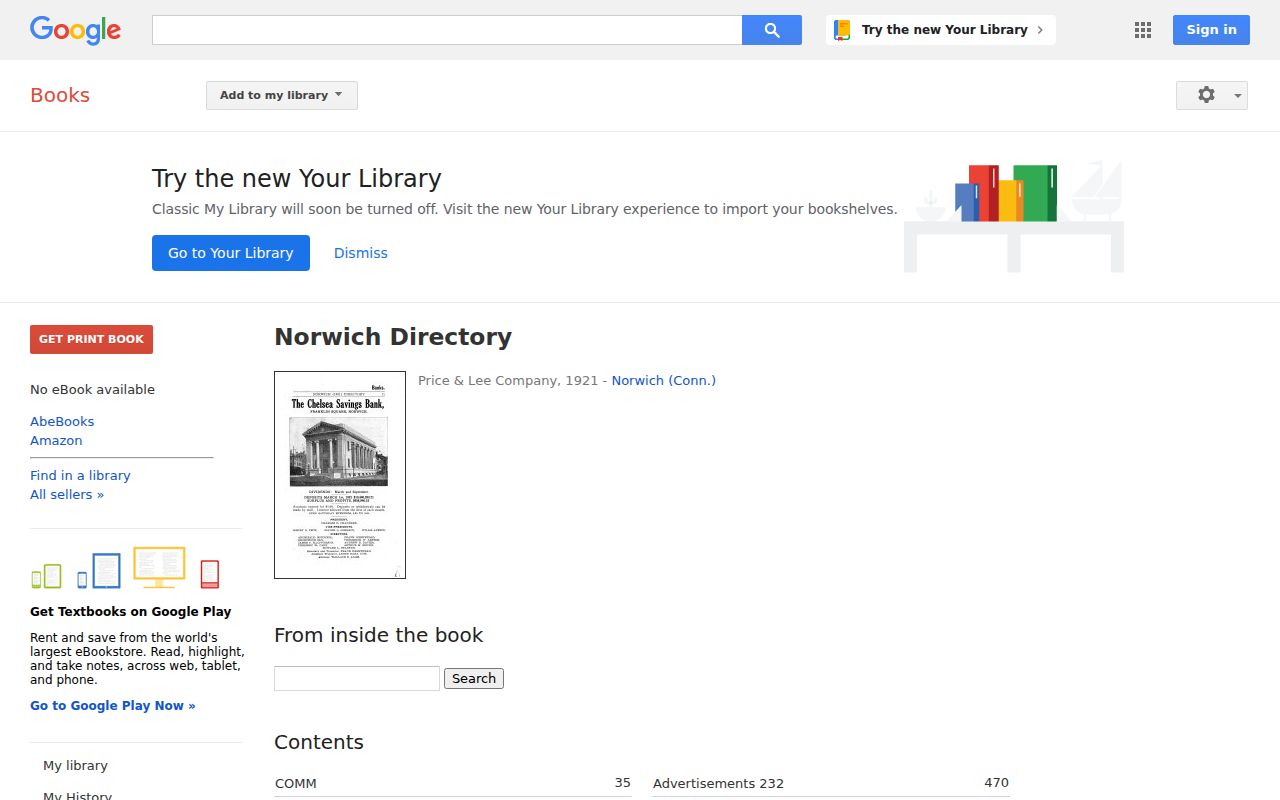
The street section is not a modern occupant list. It is a second index that must be read with the printed year, page, and local wording. An advertisement can identify a business or institution near a household, while a community heading can explain why an address appears outside the expected alphabetical town label.
When a name find needs a current, address-keyed check, the modern parcel and street workflow belongs in the Norwich street directory lookup, not in a reconstruction of the historical shelf.
Eastern's Norwich Directory Backup
Eastern Connecticut State University supplies a valuable backup when an Otis volume is unavailable or a year needs a regional comparison. Its Connecticut Studies collection lists Norwich directories from 1861-1960 and includes a Stedman's 1861 title image. The range overlaps the Otis shelf, the Stedman run, and the early Price & Lee years, so it can help distinguish a true missing year from a catalog or shelf gap.
The Eastern Connecticut State University Connecticut Studies collections show the alternate institutional route.
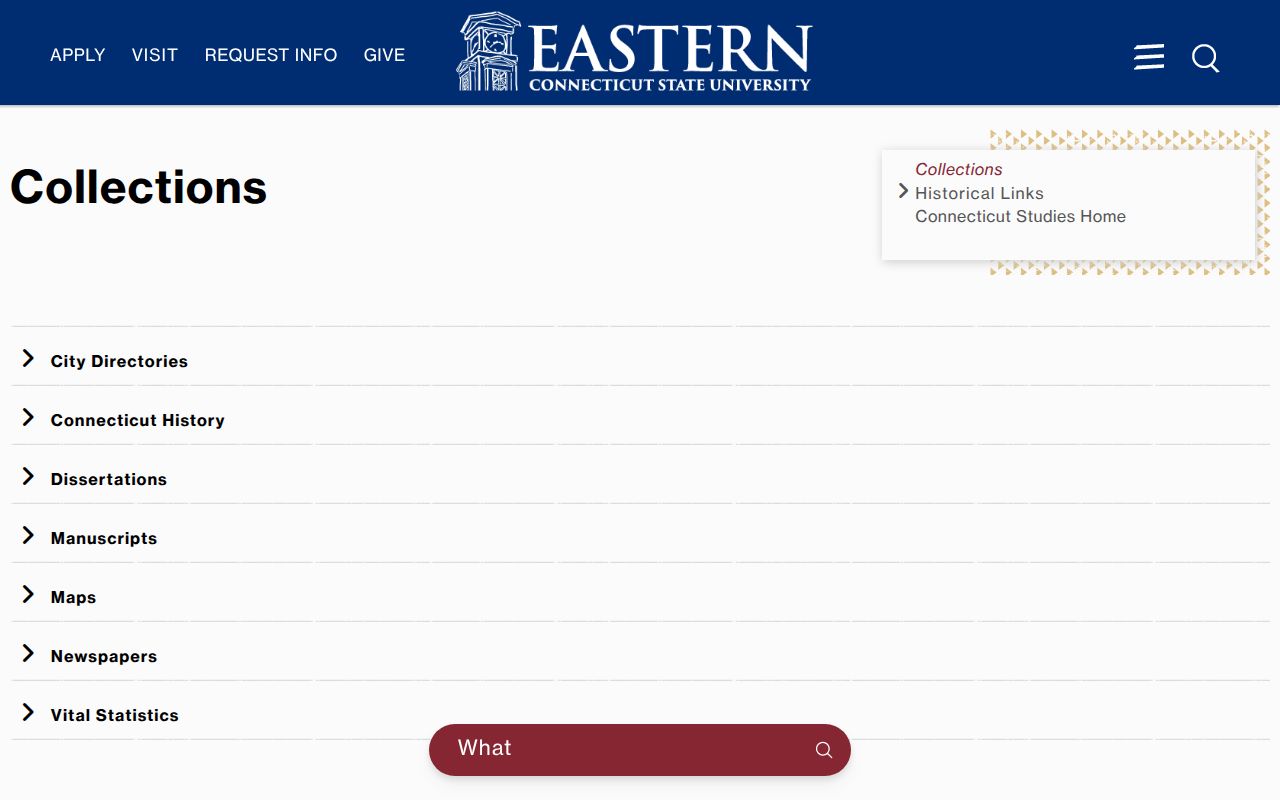
Two other fallback references matter. The New York State Library city-directory guide lists Norwich 1846, 1857, and 1860 on fiche, while the National Archives city-directory guide identifies Norwich material for 1927-1932. These are access leads, not a promise that every reel or volume can be read online. Ask about reader access, reproduction rules, and the exact title before relying on a short citation.
Norwich City Directories for Family History
For family history, a Norwich city directory is most useful as a year-by-year bridge. Begin with the clearest name and address, then keep the original spelling while comparing nearby years. Pair directory dates with the closest public census releases, especially 1870, 1880, 1900, 1910, 1920, 1930, and 1950. The 1890 federal schedules were generally lost, so a directory can carry the household across that gap.
- Find the first plausible entry and record its page, address, work or status descriptor, and any spouse or family note.
- Check the next directory year or the next available volume. Mark a move, a change in work, a widow notation, and any change in initials.
- Turn to the street or community section. Search Taftville, Yantic, Norwich Town, Occum, Laurel Hill, or a mill name when a surname search stalls.
- Pair each directory run with a census year. Compare names in the household, ages where available, birthplace clues, and the address or enumeration district.
- Close an apparent disappearance with the Bulletin Index, an obituary abstract, cemetery evidence, a vital index, or a probate lead.
A person who vanishes from one volume may have moved, died, changed a surname, entered a household under another person, or simply been omitted. A later directory, church record, yearbook, or newspaper notice can separate those possibilities. Keep a source log so a likely family match does not become a fact before a second record supports it.
Norwich Bulletin Clues for Directory Research
The Norwich Bulletin is a strong companion when a directory leaves a gap. Otis holds Bulletin microfilm and bound volumes, plus an index covering 1865-1930. The library is also digitizing historic Bulletin editions with grant support and placing material on the Internet Archive. The Library of Congress record for the paper supplies a free scan and text route for digitized issues, while Chronicling America is identified for a 1910-1922 segment.
The Library of Congress Norwich Bulletin record can help test a name, address, legal notice, marriage announcement, or death notice against the printed directory. A notice is a lead, not a certified death record, and an obituary may give a later address rather than the address where a person lived during the directory year.
Otis also holds New London Day and New York Times microfilm, cemetery and obituary abstracts, and Norwich Free Academy yearbooks. FamilySearch catalogs Norwich church records from about 1660-1928 and Connecticut marriages from 1640-1939. Church entries can add parents, sponsors, congregations, or burial links that a city directory never printed. Use the cataloged collection as a research lead and check image rights or an archive copy.
Norwich Neighborhood Vocabulary in Directories
Local place words are part of the index. Stedman's 1870 examples use N T and B H, abbreviations that point toward Norwich Town and Bean Hill. Later contents and local-history sources use Taftville, Yantic, Occum, Laurel Hill, Shetucket, Norwich Town, Downtown, Greeneville, Chelsea Parade, East Side, West Side, and other planning or historic-district labels. A family can be easy to miss if a search is limited to a modern street name.
The Norwich Historical Society at 69 East Town Street adds heritage context, historic-district material, and local research connections. Its public contact is 860-886-1776, with info@norwichhistoricalsociety.org listed in the research material. No dedicated public house-history guide was located, so the Society, Otis, Eastern, maps, and the printed volumes work best as connected research stops.
Norwich's 1952 city and town consolidation is another checkpoint when older records use Norwich City, Norwich Town, or a neighborhood or mill label. Pair the printed term with the directory year, a map or Sanborn sheet, and the record custodian's description. That keeps a historical directory entry in its own time instead of forcing it into a modern boundary.