
Norwich Previous Residents: Source Coverage
A backward address search works best when ownership, occupancy, building history, and family events stay separate. New London County is geographic, not a county-clerk route. Norwich's City Clerk, Assessor, libraries, Building Department, Probate District, and state systems each hold one piece.
| Source | Years It Covers | Where Held | What It Shows |
|---|---|---|---|
| Norwich City Clerk land index | Online start not stated; a local guide describes 1659-present | Paid subscription, clerk counter, deed books | Recorded parties, dates, book/page, legal descriptions |
| Assessor and MapGeo parcel card | Current assessment data; historic cutoff not stated | Norwich Assessor, Vision, MapGeo | Situs, mailing address, owner, parcel ID, value |
| Otis city directories | 1846-1986 holdings | Otis genealogy and local-history collection | Names, addresses, occupations, local businesses |
| Stedman and Price & Lee | 1861-1874; 1875-1920, later endpoint disputed | Otis, Eastern, scans and references | Historical household and address entries |
| Federal census | 1790-1950 public under the 72-year rule | Otis, NARA, authorized databases | Household members and census-date context |
| Sanborn fire-insurance maps | 1885, 1892, 1895, 1897, 1903, 1909, 1914, 1926 | LOC, Otis and map collections | Footprints, materials, use, number and lot context |
| Bulletin and obituary sources | Index 1865-1930; scans and 1910-1922 coverage | Otis, Internet Archive, LOC, Chronicling America | Deaths, moves, notices, legal and family links |
| Permits and inspections | Current ViewPoint and OpenGov; older cutoff not stated | Norwich Building Department | Work, inspections, certificates and address events |
| Probate District PD29 | Online data Jan. 5, 2011-present; older files by court | Connecticut Probate lookup and court file | Estates, fiduciaries, heirs and case status |
Start with the source that matches the question. MapGeo and the Assessor anchor a current parcel, the City Clerk anchors title, and Otis, census, newspapers, and vital or church indexes anchor households. Sanborn sheets and permits add building dates. No single row supplies every previous resident.
Starting a Norwich Previous Residents Search
The current parcel card anchors previous residents research with stable identifiers. The free Norwich MapGeo viewer accepts an owner, street, parcel ID, or indexed term. The Vision Government Solutions Norwich Assessor search is a second route. Save the situs, mailing address, owner, map ID, book/page, and view date.
A Norwich sample makes the distinction plain. The 25 SHIPPING ST card lists parcel ID 117-004-044.000-0000, CASTLE REALTY LLC C/O EMMET OIL CO, and PO BOX 266, STONINGTON CT 06378. It also shows $48,000 total value, $47,200 land value, a 1995-03-07 last sale, book/page 1205/114, 0.69 AC, and zone GC.
| Situs address | 25 SHIPPING ST, the physical parcel location. |
|---|---|
| Mailing address | PO BOX 266, STONINGTON CT 06378, a tax-roll correspondence address. |
| Parcel key | 117-004-044.000-0000, a stable map identifier for the next search. |
| Recorded lead | Book/page 1205/114 and the last-sale reference, both leads for the City Clerk index. |
The sample is an assessment record, not proof of occupancy. Preserve both addresses, then use the legal description and parcel ID instead of turning a tax contact into a household claim.
Norwich Previous Residents: City Clerk Index
Norwich has no county clerk or county recorder. The City Clerk performs the local recording function, and the Norwich land-record page directs users to a paid subscription. Plans are one week for $50, one month for $100, six months for $250, or one year for $450; an annual plan may include up to five users. Payment can be by business check, Visa, Mastercard, Discover, or money order, not a personal check.
The index requires assigned credentials, bars resale, and excludes images and map indexing. Its start year is not displayed. Search modes include party, document type, date range, consideration, instrument, book/page, lot/block, legal description, and map number. Results can show parties, type, dates, book/page, consideration, descriptions, linked documents, and image notices.
Use the counter for the unknown cutoff, maps, restricted images, or certified copies. The City Clerk is at 100 Broadway, Room 215, Norwich, 860-823-3732, fax 860-823-3790. The current notice ends walk-in land recording at 3:00 p.m. and closes the office at 3:30 p.m.
Index gap. The online starting year was not located in official sources. A missing web result is a prompt to ask for the deed-book range, not proof that no earlier Norwich record exists.
Norwich Previous Residents: New London Deed Chain
The functional deed route runs through the Norwich City Clerk even when a search is described as a New London County record search. Begin with today's assessor card, then walk the recorded chain backward. A seller becomes the next grantee to find, and the legal description helps when a street number has changed. Record each deed's date, parties, consideration, book/page, lot or map reference, and corporate or estate capacity.
- Save the current MapGeo or Vision card, including the owner, situs, mailing address, parcel ID, value, and book/page.
- Search the City Clerk index for the current owner as grantee. Try spelling variants, company formats, book/page, instrument number, and the legal description.
- Read the deed for the grantor, prior instrument, lot or map reference, and the description that identifies the parcel beyond its street number.
- Search that seller as the next grantee. Repeat the handoff backward, keeping a dated line for each transfer and noting any trustee, estate, or business name.
- When the online index stops, ask the clerk for the relevant bound book, microfilm, image, or certified-copy route. Do not fill the gap with an assumption.
- Grantor / grantee
- The grantor transfers an interest. The grantee receives it. In a deed search, the seller is usually the grantor and the buyer the grantee.
- Chain of title
- The linked sequence of recorded transfers for one parcel, traced from a later grantee back through earlier grantors.
- Legal description
- The lot, map, subdivision, metes-and-bounds, or other written description that identifies land more reliably than an old street number.
- Criss-cross directory
- An address-order directory that can add occupants to an owner trail, though it is separate from a deed and must be cited by year.
- Enumeration district
- A census-area unit used by an enumerator. It can help locate a household when the census page does not give a precise street address.
Norwich Previous Residents and Sanborn Maps
Sanborn sheets test whether a building and number existed when a directory or deed used them. Norwich references locate sheets for 1885, 1892, 1895, 1897, 1903, 1909, 1914, and 1926. They show footprints, materials, outbuildings, use, numbers, and lot context, not every person who lived there.
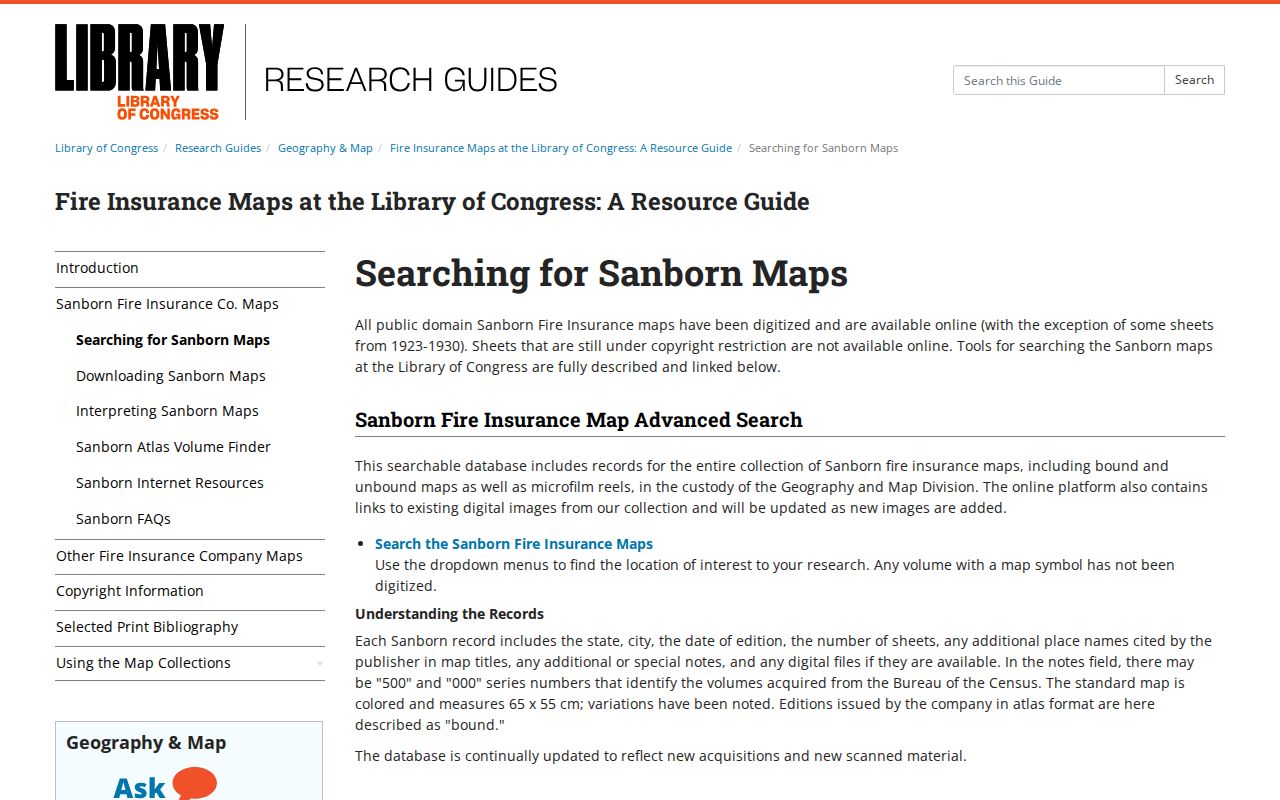
The Library of Congress Sanborn search guide explains how the city record, date, sheet count, and street index work together. The 1897 Norwich Sanborn map item supplies the direct sheet-set record for that crosswalk.
When a directory number disappears, compare the street index, adjoining streets, lot shape, footprint, and neighborhood name. Carry the best match into the City Clerk legal description or current parcel ID. A Sanborn sheet can show a structure or alteration, but not occupancy.
Norwich Previous Residents: Directories and Census
Owners are only one layer of a house history. Otis's Norwich City Directories run from 1846-1986; Stedman covers 1861-1874, and Price & Lee references begin in 1875 with a disputed endpoint. The Norwich directory book collection explains the printed runs. Pairing a directory year with a census year strengthens the address trail.
- Start with a directory entry close to the target year. Capture the exact street, number, occupation or status, and any spouse or household note.
- Compare a 1870 or 1880 entry with its census, then use the 1900, 1910, and 1920 schedules and NARA's 1927-1932 directory reference around 1930.
- Use the 1950 census as the latest broadly public decennial census under the 72-year rule as of 2026. Remember that the 1890 federal schedules were generally lost.
- Check the street or community section when the entry uses Taftville, Yantic, Norwich Town, Occum, Laurel Hill, Shetucket, N T, or B H instead of a modern street.
- Mark the result as an occupant lead, not a certainty, until an obituary, church record, vital index, deed, or second directory supports the same household.
Directory disappearance can mean a move, death, name change, household change, or omission. The 1950 census, Otis microfilm, Eastern, New York State Library fiche, and NARA guide provide fallback routes.
Norwich Previous Residents in Obituaries and Probate
The Norwich Bulletin can close a directory gap. Otis holds its 1865-1930 index, microfilm, and bound volumes; the Library of Congress has a searchable record, and Chronicling America coverage is identified for 1910-1922. Notices can show a death, move, legal matter, or family link, but an obituary is not a certified vital record.
Probate is a separate endpoint. District PD29 is at 100 Broadway, Room 122, 860-887-2160. The lookup covers Jan. 5, 2011-present and exposes case type, district, status, first name, and last name. Older files and many images require court access. An heir address is a dated legal contact, not proof of occupancy.
Compare a notice with a Norwich vital index, cemetery evidence, FamilySearch church records, or probate. FamilySearch catalogs Norwich church material from about 1660-1928; the clerk, cemetery office, library, or court can confirm a lead.
Norwich House History Through Permits and Inspections
Building records date a structure, not a complete list of previous residents. Norwich routes permits through ViewPoint Cloud and inspection requests through OpenGov. Use the address, permit number, and inspection type for plan review, alterations, certificates, demolitions, complaints, or enforcement.
The Building Department is at 23 Union Street, first floor, 860-823-3745. Inspection help is listed at 860-823-3766 or 860-823-3739, with hours of 9:30 a.m. to 3:00 p.m. Older permits may remain on a former system; ask staff for the series when a portal has no result.
A permit applicant is not automatically an owner or occupant. Use the date with a Sanborn map or photograph, then return to deed, directory, census, or newspaper evidence.
Norwich Address History and the 1952 Consolidation
Norwich's old address vocabulary can reflect Norwich City, Norwich Town, a mill, landing, or neighborhood. The 1952 consolidation is a useful checkpoint, along with Norwichtown, Greeneville, Taftville, Occum, Yantic, Bean Hill, Laurel Hill, Shetucket, Chelsea Parade, Downtown, East Side, and West Side.
No complete citywide street-renumbering table was located. Keep the old street name, cross streets, owner, parcel or map ID, legal description, neighborhood or mill label, and book/page together. Compare the 1878 Stedman map and a Sanborn sheet, then ask the City Clerk or Planning office about a particular change.
The original 1659 Mohegan deed to the Town/Inhabitants of Norwich was not found, but a copy was recorded at Hartford in 1663 and later in Norwich or New London records. Follow records across custodians instead of treating a missing original or web result as the end.
Once a historic number is crosswalked, the current address chain can be checked through the Norwich street directory lookup for parcel and address-keyed records. Keep the modern and historic identifiers side by side.
Past Norwich Households: Directories, Census, and Obituaries
A careful house history separates title, tax mail, household appearance, and dated events. Deeds, assessment cards, directories, census schedules, newspapers, vital indexes, cemetery material, and probate each answer a different question. A gap may reflect privacy, a missing volume, an old system, a changed name, or no record.
Tie every finding to its year, page, parcel, case, book, or image. Do not merge an owner, mailing recipient, permit applicant, voter, heir, and occupant. That supports genealogy, historic-house work, an estate question, or local history.
Lawful house history. Norwich address research is for personal history, genealogy, property history, and civic understanding. Do not use a record to stalk, harass, threaten, or track a living person, and respect protected records and confidentiality programs.